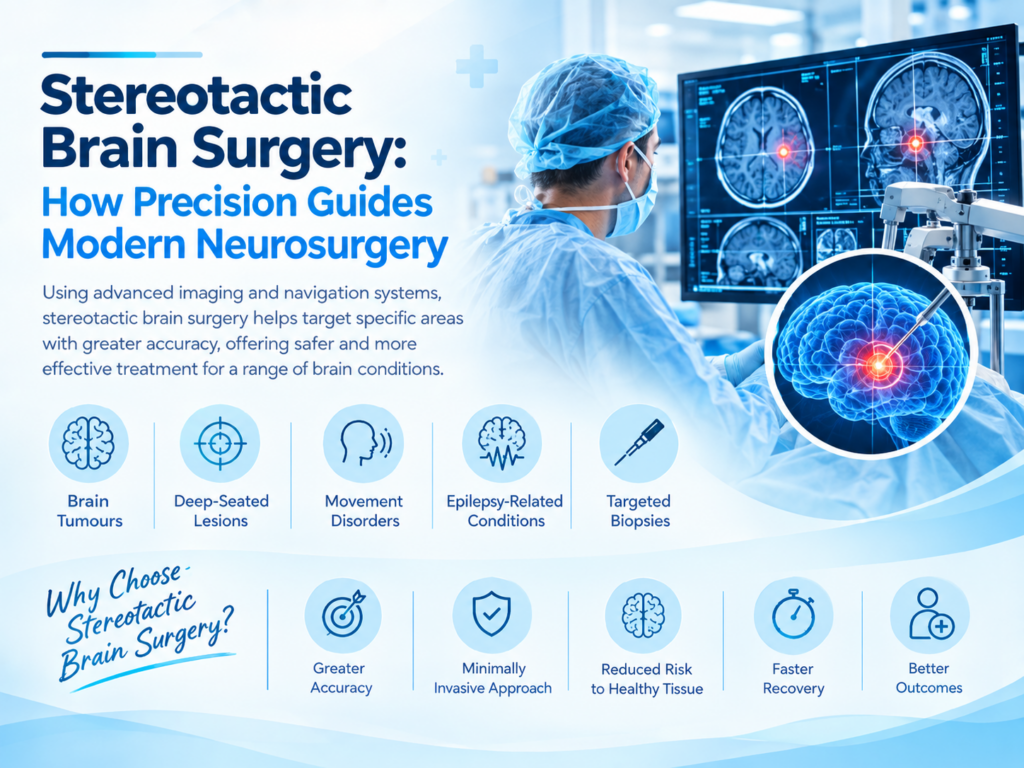
Modern neurosurgery increasingly focuses on reaching the affected area accurately while limiting unnecessary disturbance to surrounding brain tissue. Stereotactic Brain Surgery in Thane represents this precision-focused approach, using detailed imaging and specialised guidance systems to identify and target specific areas of the brain. This on-page blog for the Stereotactic Brain Surgery service offered by Dr. Nilesh Potdar explains how the technique works, when it may be considered, and what patients can expect during the treatment journey.
What Is Stereotactic Brain Surgery?
Stereotactic brain surgery is a specialised neurosurgical technique that uses detailed CT or MRI imaging to create a three-dimensional map of the brain. This map helps the surgical team identify a particular target and plan an appropriate route while taking important surrounding structures into consideration. The approach can be useful when the affected area is small, deep within the brain, or located in a region where conventional access may be more complex.
Unlike the idea of traditional open-brain surgery, stereotactic procedures are designed around precise targeting. Depending on the condition and treatment objective, the technique may be used for brain biopsies, selected tumour procedures, certain neurological disorders, movement disorders, or targeted radiation-based treatments. Whether it is appropriate depends on the diagnosis, location of the problem, imaging findings, and overall clinical condition.
How Does the Precision-Based Approach Work?
Planning is an important part of Stereotactic Brain Surgery in Thane. Before treatment, imaging such as MRI or CT may be used to identify the exact location of the abnormality. The information from these scans can then be incorporated into a stereotactic navigation or targeting system.
During the procedure, the surgeon follows the planned trajectory to reach the intended area. The technique may involve specialised guidance equipment, depending on the type of procedure being performed. The goal is to improve targeting accuracy and avoid unnecessary manipulation of healthy brain structures.
This precision can be particularly relevant when the target is located deep inside the brain or close to important functional areas. However, every brain condition is different, so the surgical method and expected recovery should be discussed individually with the treating neurosurgeon.
When May Stereotactic Brain Surgery Be Considered?
Stereotactic Brain Surgery in Mulund may be considered for selected patients with deep-seated brain lesions, certain brain tumours, movement disorders, epilepsy-related conditions, or lesions that require a precise biopsy. The technique can also be associated with targeted radiation approaches such as Gamma Knife treatment in appropriate cases.
Some symptoms that may lead to neurological evaluation include persistent headaches, seizures, changes in vision or speech, coordination difficulties, cognitive changes, or ongoing neurological symptoms. These symptoms do not automatically mean that stereotactic surgery is required. Instead, they may indicate the need for appropriate neurological assessment and diagnostic imaging.
For patients with brain tumours or related neurological conditions, treatment planning may involve more than one specialist. Neuro-oncology care can combine surgery, radiation therapy, medicines, and other treatment approaches according to the type and characteristics of the condition. Patients can also review the available neuro-oncology care in Thane when considering treatment options for brain tumours.
What Happens Before the Procedure?
Before Stereotactic Brain Surgery in Thane, the medical team generally reviews the patient’s symptoms, medical history, neurological examination, and imaging reports. MRI or CT imaging can help establish the location and characteristics of the area being targeted. The surgical team then plans the safest and most appropriate route based on the individual case.
Patients may also be advised to undergo additional investigations depending on their diagnosis and planned procedure. A clear discussion about anaesthesia, expected hospital stay, possible risks, recovery, and follow-up can help patients understand what to expect.
When brain problems are related to an injury, assessment may follow a different pathway. For patients requiring evaluation or treatment after significant head trauma, information about traumatic brain surgery can provide context about how traumatic neurological conditions are managed.
Recovery and Follow-Up
Recovery after Stereotactic Brain Surgery in Mulund varies according to the procedure performed, the condition being treated, the patient’s general health, and the location of the targeted area. Some minimally invasive procedures may involve a shorter recovery period than more extensive conventional operations, but there is no single recovery timeline that applies to everyone.
Follow-up is an important part of care. Depending on the diagnosis, patients may require repeat imaging, neurological assessments, medication adjustments, or additional treatment. For individuals being treated for brain tumours, coordinated care may be relevant when treatment involves multiple specialties.
Why Individualised Planning Matters
The key feature of Stereotactic Brain Surgery in Thane is precision, but precision begins before the procedure itself. Detailed imaging, careful planning, appropriate patient selection, and experienced neurosurgical decision-making all contribute to determining whether the technique is suitable.
Dr. Nilesh Potdar is an MBBS, MS (General Surgery), and M.Ch. (Neurosurgery) specialist with experience in brain and spine procedures. He also works as an Endoscopic Spine & Brain Surgeon and is associated with Mercurrey Hospital in Thane and Galaxy Super Speciality Hospital in Mulund.
Frequently Asked Questions
1. What is stereotactic brain surgery used for?
It may be used for selected brain tumours, deep brain lesions, biopsies, movement disorders, epilepsy-related conditions, and certain targeted treatments. Suitability depends on the individual diagnosis.
2. Is stereotactic brain surgery minimally invasive?
The technique is designed for precise targeting and may involve less extensive access than conventional open procedures. The exact approach depends on the treatment being performed.
3. How is the target identified?
MRI or CT imaging can create detailed images that help the surgical team establish the location of the area requiring treatment.
4. How long does recovery take?
Recovery varies according to the procedure, diagnosis, and individual health. Some patients may resume normal activities within days or weeks, while others require longer monitoring and rehabilitation.
5. Is stereotactic brain surgery suitable for everyone?
No single procedure is appropriate for every patient. A neurosurgeon evaluates the diagnosis, imaging, symptoms, overall health, and treatment goals before recommending an approach.